
ENG | ESP
PRIMARY EDUCATION UNDER THREAT
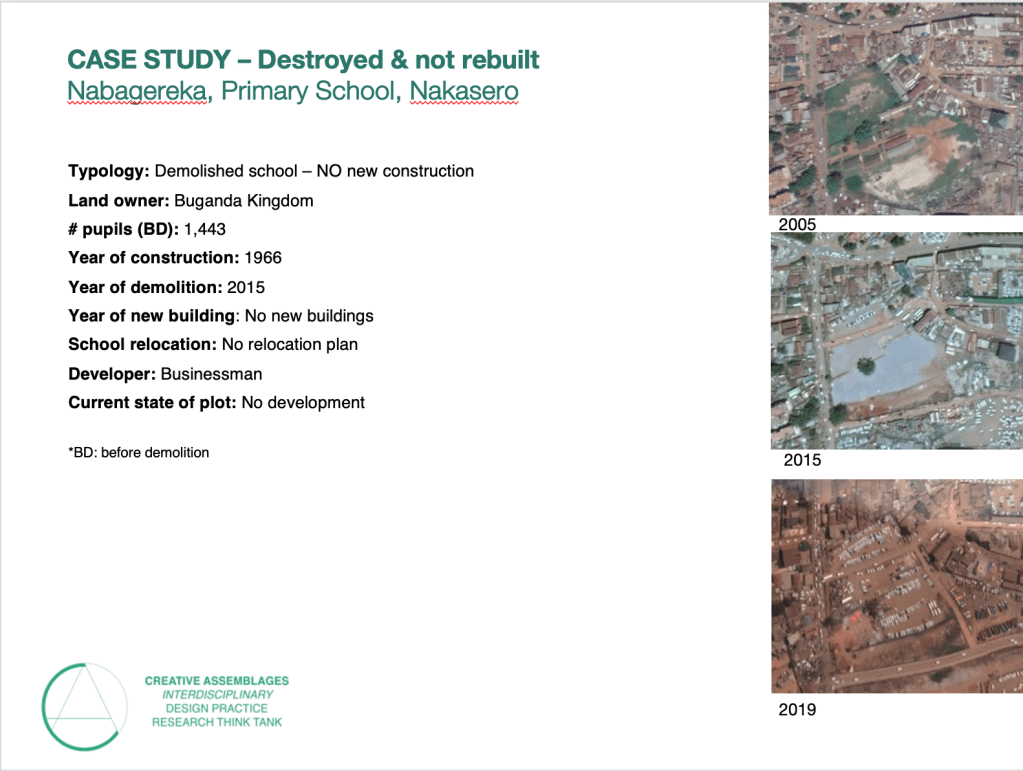
This research project investigates the demolition of public primary school facilities in Kampala for private real estate development. It explores spatial solutions including density, verticality, reduced footprints, and a multipurpose uses.




Project Type //
Research, Design phase
Chronology//
2019
Location //
Kampala, Uganda
Team//
PI – Nerea Amoros Elorduy
CoI- Emily Akers
In 2019. some sources suggest that at least 57 out of 79 government-aided primary schools under the jurisdiction of Kampala Capital City Authority (KCCA) are at risk due to land issues and tenure.
Public primary school facilities in non-public land in urban Kampala are being demolished to make way for money-making real estate developments. This poses a slow but relentless threat to public education in the city and is a result of several challenges. These challenges include inefficient use of land in primary school facilities, inadequate government funding for the repair and maintenance of public urban schools, lack of projects or policies that attract funds for urban schools and child-friendly cities, increasing land value in the central area of Kampala, growing investor interest in construction development for commercial projects in city centers (such as malls, housing, offices, and hotels), the need for urban densification to increase the efficiency of services and accommodate the growing urban population, widespread corruption in land management and construction projects by local and government officials and investors, and a lack of participation of civil society and various stakeholders in urban policies and project development.
To address these challenges, embracing density and innovative solutions to spatial challenges is necessary. This includes limited footprint and vertical distribution, neighbourhood representation and sensibility to the context, a complex urban setting, feasibility, affordability and sustainability, multi-use spaces, adaptation, and cost efficiency, and the school as a community resource.
Efficient use of limited land is important, and the design process should consider traffic, accessibility, parking, and social space. The design should aim to maximize internal program space while reducing the overall footprint, and flexible and multipurpose spaces should be created. Moreover, schools should extend their daily use beyond the educational needs to offer resources to the entire community.
 CREATIVE ASSEMBLAGES