
ENG | ESP
FLOR DA MANHÀ ECD SCHOOL
The stabilised earth block buildings are positioned, oriented, and finished to sustainable harness the climate and resources to create a stimulating inner courtyard and a comfortable school.


Project Type //
Educational facility, Competition
Chronology//
2021
Location //
Xia Xia District, Mozambique
Team//
Nerea Amoros Elorduy
Tomà Berlanda – a.studio.space
Sunniva Viking – a.studio.space
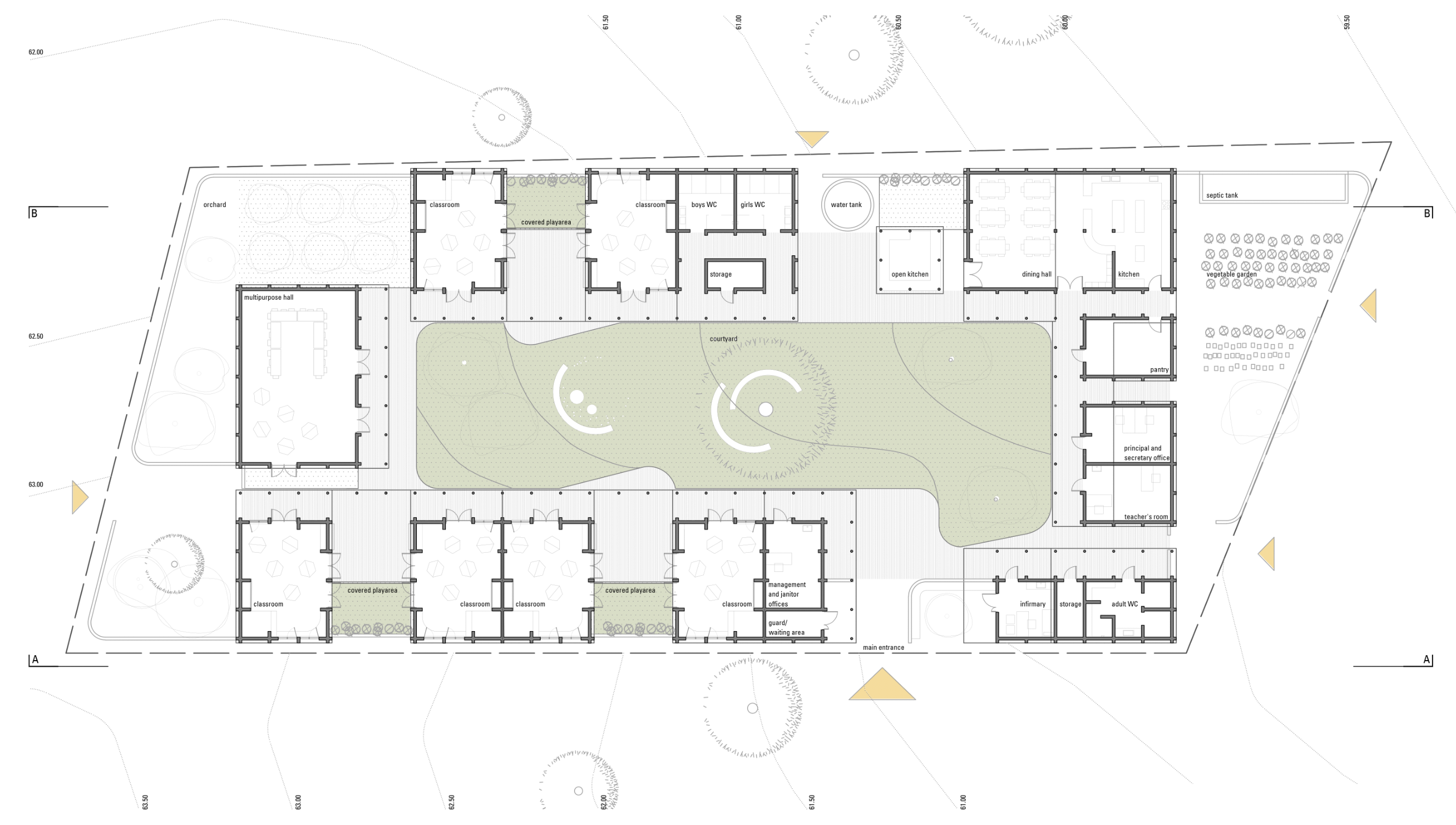
The preschool Flor da Manhà, a collaboration with a.studio.space, is conceived as a small village where children and caregivers can experience a nurturing community environment. The design revolves around the idea of utilizing the buildings as a perimeter fence to create one main safe and protected space for children inside the compound. The orientation of the buildings takes into account the prevailing seasonal winds, monsoon rains, and tropical sun angles. The main entrance is located on the east side, and the circulation under covered passageways takes advantage of the moderate slope of the terrain, allowing for universal access.
Our experience in designing child-friendly schools and early childhood development has led us to organize of the program into two parts: the higher side of the plot (south) features a multipurpose hall that serves as a pivot for adjoining classrooms and covered outdoor play areas, while the north side houses the kitchen and dining hall, administrative offices, and wet areas.
The aim is to use architecture as an additional educator, creating a stimulating and enriching environment for children through multiple configurations and usages of the spaces. Each classroom has a dedicated covered outdoor play area and contains enough opportunities to facilitate the work of caregivers in nurturing growth in its footprint.
To minimize the use of imported materials, the load-bearing walls use Interlocking Stabilized Soil Blocks (ISSB) laid out in a 2m grid, with reinforced buttresses serving as a lateral and vertical framework.
The roof uses an overlapping IBR metal sheet fastened to metal RHS beams. Fenestration is achieved with metal frames and external louvres to provide shading and protection. Rainwater harvesting is channeled to an underground water tank connected to a solar-powered pump, while sewage is treated with a septic tank located on the lower northern corner.
 CREATIVE ASSEMBLAGES